250 Church Street | NYC
Original Construction: 1949
Construction Type: Reinforced concrete with ribbon windows and brick masonry façade
Category: Material Science / Building Technology
Scope: Leak Investigation and Brick Masonry Consulting
A Study in Transitional Masonry, Misdiagnosis’, and Systemic Façade Failure
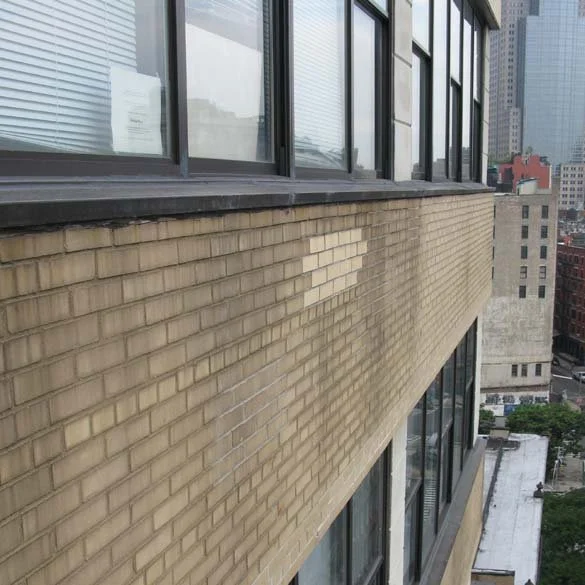
Our team was engaged to investigate persistent water infiltration at the building façade and to develop a scope of work for the replacement of the ribbon windows throughout the structure. Chronic leakage had been reported at window heads, jambs, and sills across all elevations, leading ownership to conclude, incorrectly, that the windows were the source of failure.
What our investigation revealed was more consequential: the windows were not the problem. The wall was. This distinction fundamentally altered both the technical conclusions and the ethical boundaries of the work.
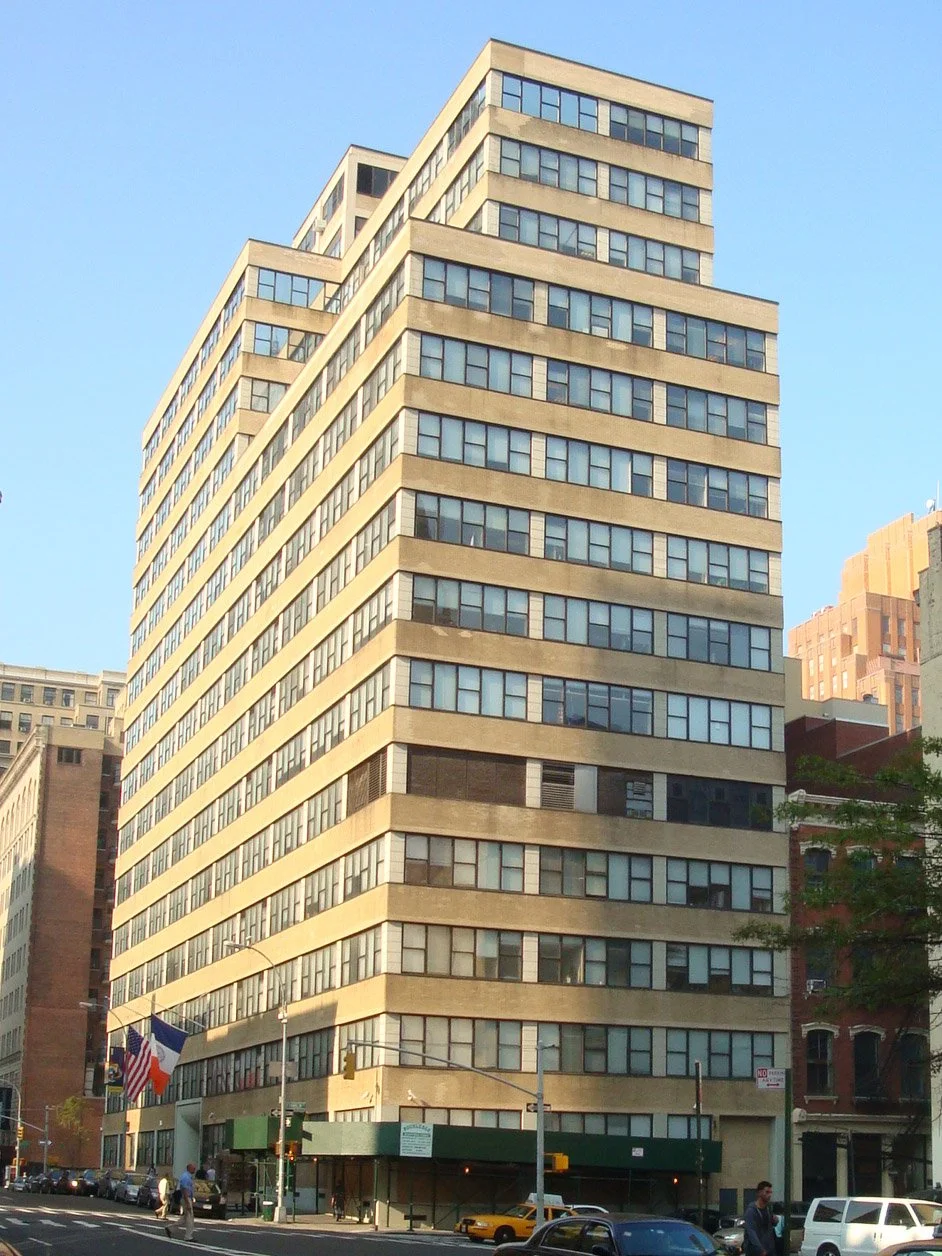
Transitional Condition
The building was constructed during a pivotal transition in masonry practice, between prewar solid masonry construction and postwar cavity wall construction. While the façade was conceived as a cavity wall system, it was neither detailed nor constructed with the clarity or discipline required for that system to perform.
Prewar masonry buildings primarily relied on mass. Thick, solid walls managed moisture through absorption, redistribution, and evaporation. Durability was achieved through redundancy rather than precision, and movement was absorbed volumetrically within the wall itself. These systems absorbed water, but they dried.
Postwar construction in New York City introduced cavity wall theory: separated masonry wythes, intentional air spaces, steel shelf angles, and the expectation that water would be collected, redirected, and expelled. Unlike solid masonry, cavity walls demand precision. They require continuity of drainage paths, control of thermal bridges, and a clear understanding of how water, air, heat, and movement interact within thinner assemblies.
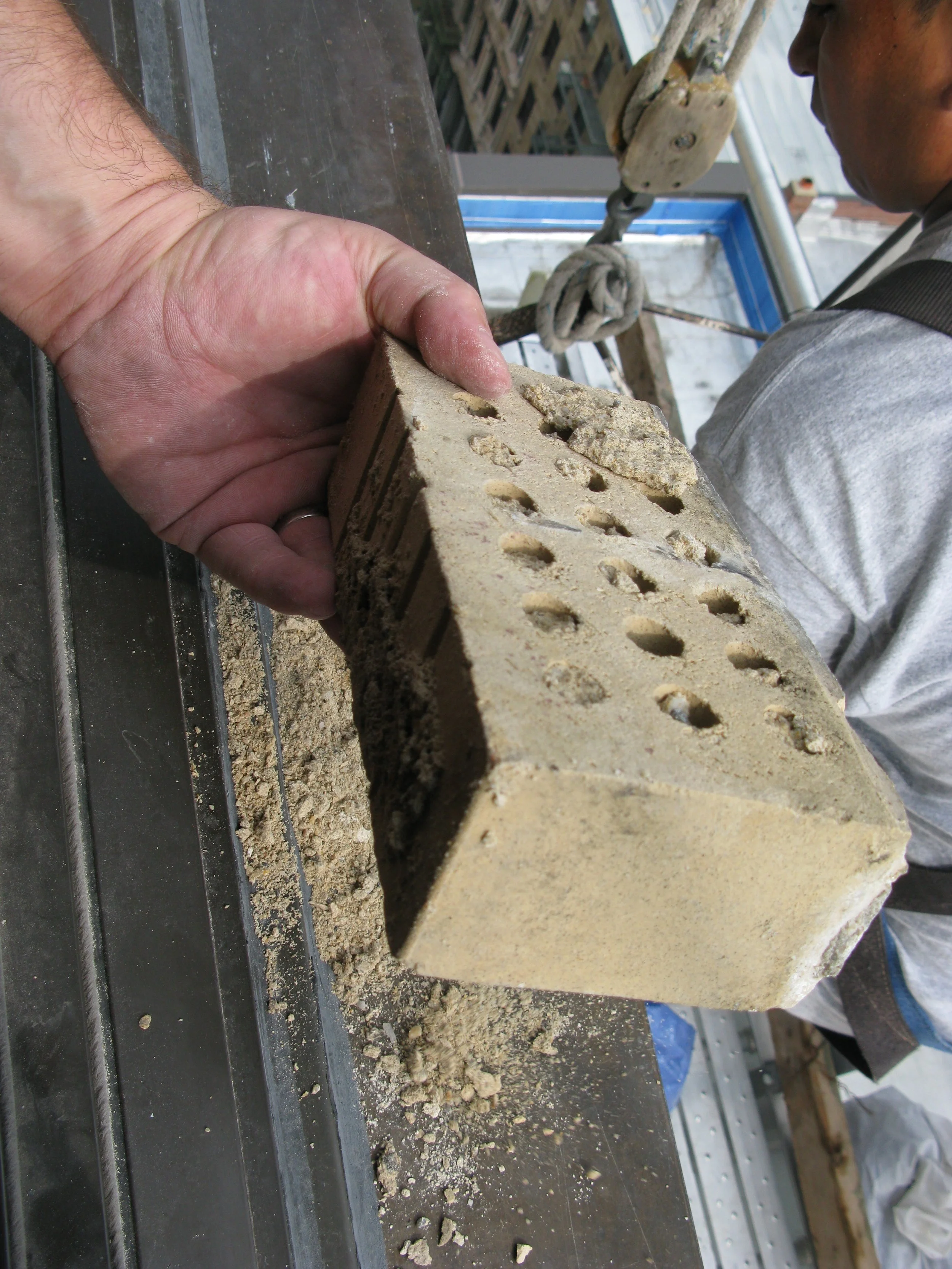
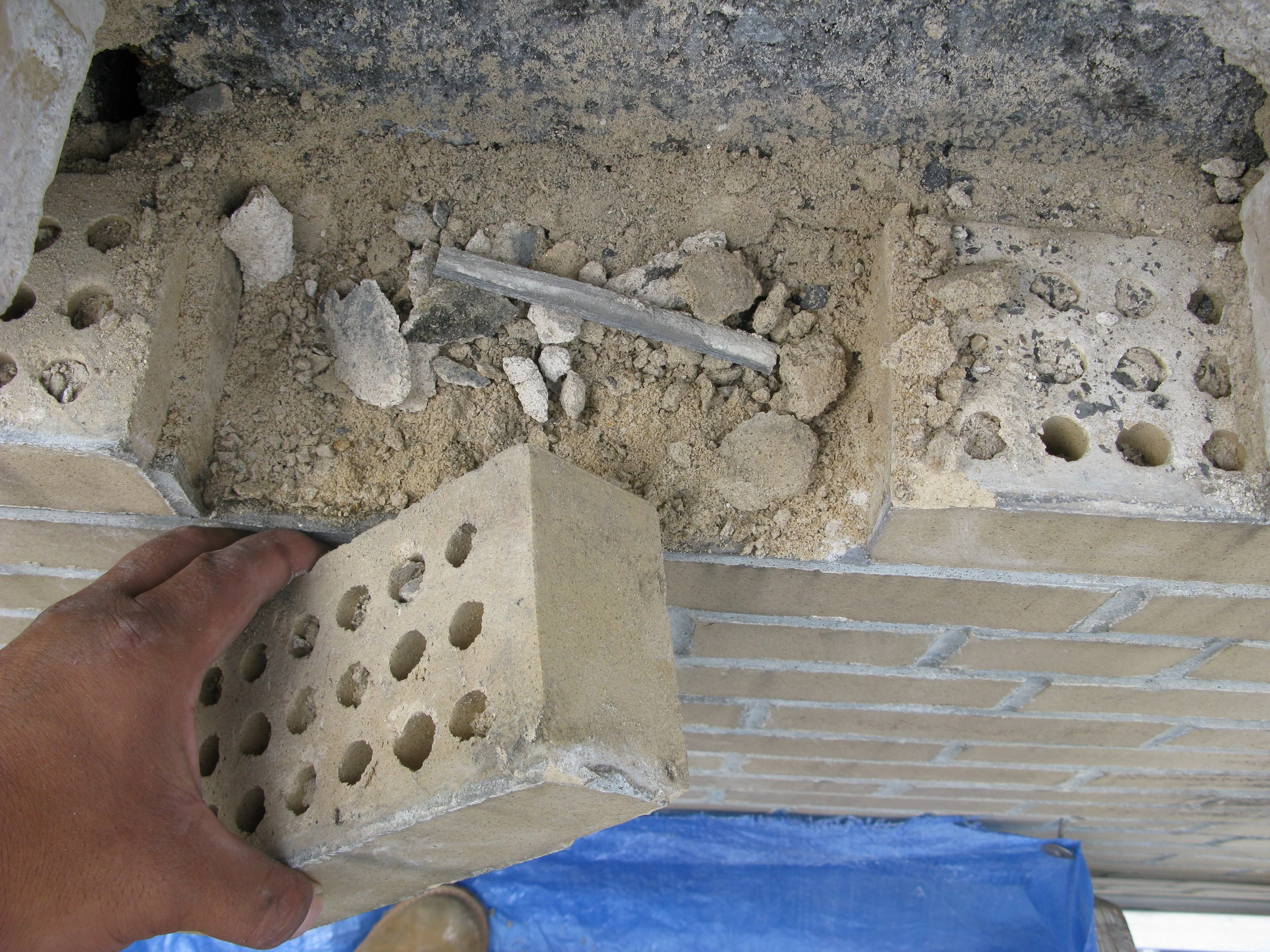
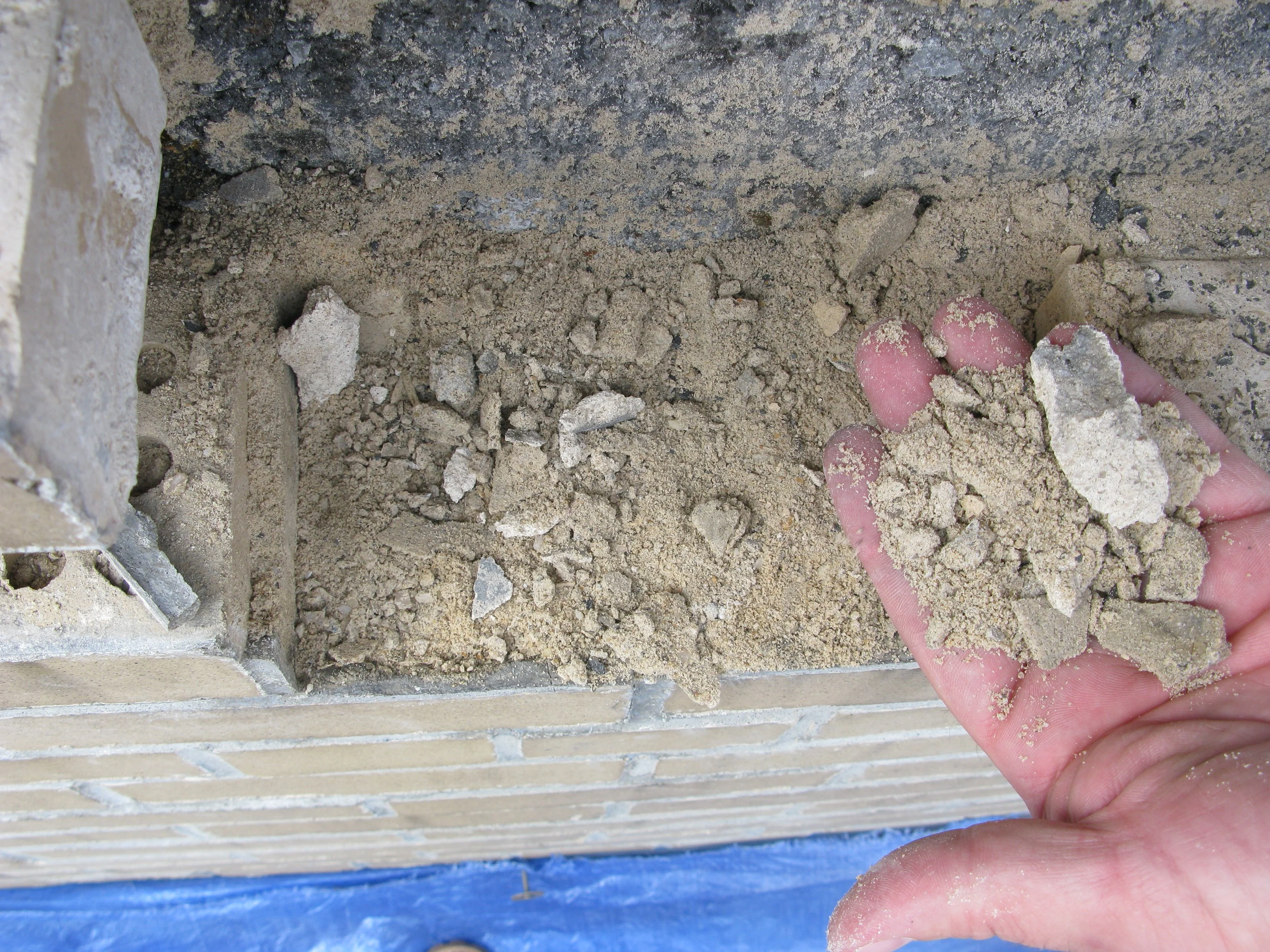
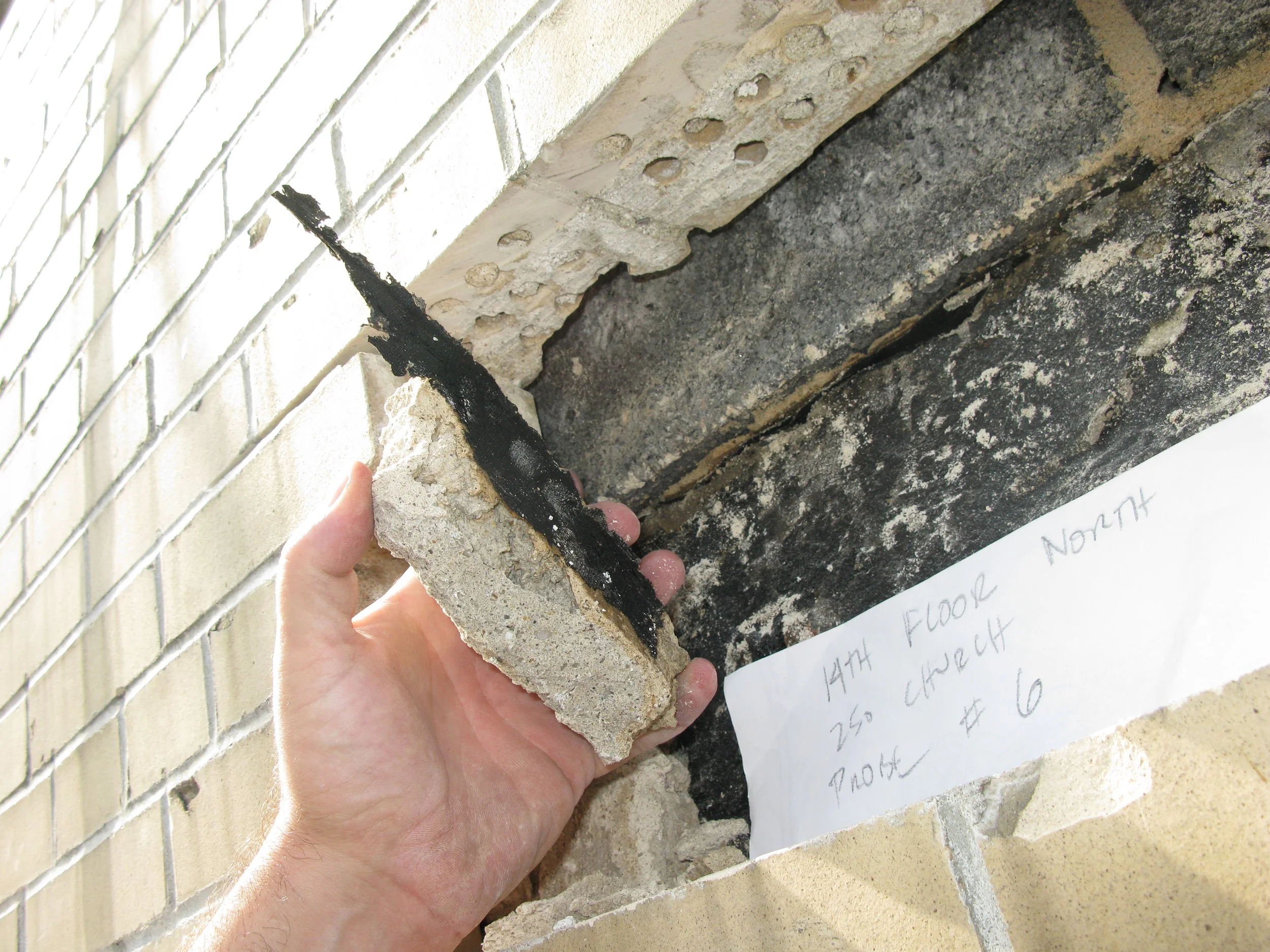
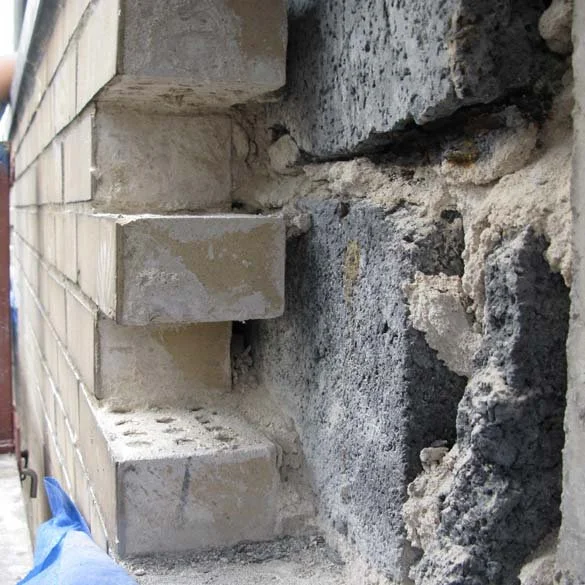
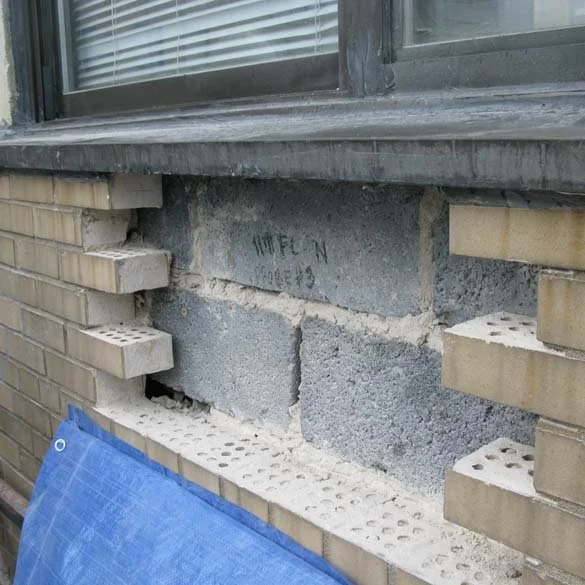
At 250 Church Street, that commitment was incomplete. Although the façade adopted the appearance of cavity wall construction, critical elements of solid masonry behavior remained embedded within the system. True brick headers were installed, physically tying the exterior masonry directly into the backup wall and eliminating separation between wythes. In many areas, the intended cavity was partially or fully filled, leaving little to no continuous air space capable of functioning as a drainage or drying plane.
Rather than operating as a cavity wall, the façade behaved as a hybrid mass assembly; without the thickness or tolerance that had historically allowed solid masonry walls to perform.
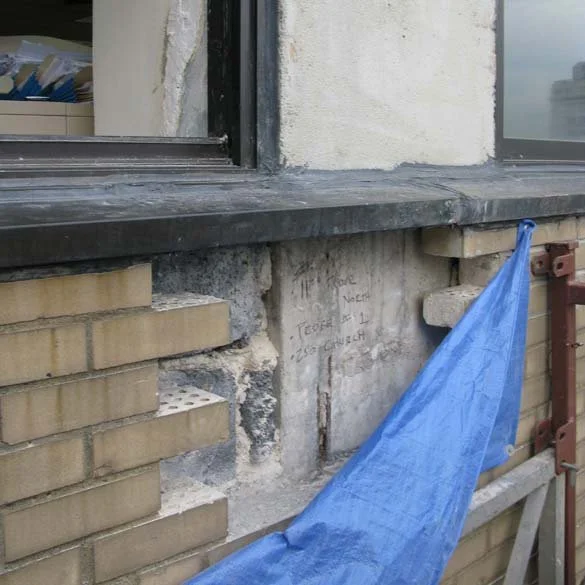
Compounding this condition were extensive thermal bridges throughout the enclosure. Reinforced concrete columns were left exposed on both the exterior and interior faces of the building, creating uninterrupted conductive paths across the wall. Aluminum flashings ran from the exterior masonry beneath window assemblies and remained exposed at interior sill conditions. While intended to manage water, these elements instead acted as continuous thermal conductors and predictable condensation planes.
Collectively, these details undermined the fundamental logic of cavity wall construction. Moisture entering the wall had no reliable exit path. Temperature differentials generated condensation within the assembly and at interior finishes. The wall was expected to perform like a cavity wall but was detailed and built with assumptions inherited from solid masonry construction.
This was not a failure of materials. It was a failure of commitment to a single system logic.
Façade Behavior and Condensation
The masonry assembly neither drained nor insulated effectively. Cavities intended to manage water were compromised or nonexistent. Steel elements embedded within masonry were exposed to moisture without adequate protection or ventilation. Thermal bridges created predictable condensation planes, independent of stormwater.
As a result, moisture accumulated within the wall assembly. During winter months, condensation formed at interior surfaces. Then, freeze–thaw cycling progressively opened new pathways for stormwater infiltration. Repairs addressed symptoms at the surface while the system itself continued to fail from within.
Why Prior Repair Attempts Could Not Work
By the time of our investigation, the building had already undergone numerous well-intentioned repair campaigns. Each effort focused on an observable symptom; water appearing at a window perimeter, staining at interior finishes, distress at relieving angles. They overlooked the behavior of the enclosure as a system. Over time, these interventions compounded the problem rather than resolving it.
Surface-applied sealants, coatings, and localized waterproofing measures increasingly restricted the wall’s ability to dry. Repointing campaigns introduced harder mortars that further trapped moisture within the masonry rather than allowing it to migrate and evaporate. Flashing systems installed at isolated locations redirected water locally without reestablishing a coherent drainage strategy across the façade. Subsequent window replacements tightened an already compromised enclosure, reducing air leakage but intensifying condensation within wall cavities that could no longer relieve moisture.
As a result, the façade became progressively more sealed on the exterior while remaining thermally and hydrothermally unstable within. Each repair addressed the appearance of failure while accelerating the underlying mechanisms that produced it. The wall was not being corrected; it was being preserved in a state of permanent distress.
This pattern of repeated intervention without systemic correction clarified a critical point in the investigation: the façade was not suffering from a failure that could be sealed, patched, or redirected. It was suffering from a failure at conception. Any measure that addressed surface symptoms without addressing the wall’s underlying logic would offer, at best, a temporary reprieve while intensifying long-term deterioration. From that moment forward, the question was no longer how to stop the leaks, but whether it was appropriate to specify a solution that could not, and would not, end the cycle.
The Only Viable Solution, and the One Not Taken
Our conclusion was direct: the only solution was a comprehensive reskinning of the building façade. Anything less would be a temporary postponement.
Ownership did not have an appetite for that scope. Instead, we were asked to specify a façade coating system to stop the leaks. We declined.
A coating here would have produced a short-term improvement; until the first winter. Then the freeze- thaw cycle would restart. Moisture would condense again at interior surfaces, and the walls would become saturated. There would be more masonry deterioration, new cracks and stormwater would reenter.
Specifying such a measure would have been a waste of money, and an abdication of professional responsibility.
Lessons from Failure
250 Church Street is not a story about defective windows. It is a case study in misdiagnosis driven by an incomplete understanding of façade behavior during a critical historical transition.
Hybrid systems fail when they inherit the liabilities of both eras while capturing the strengths of neither. Solid masonry tolerates imprecision through mass. Cavity walls demand precision through design and execution. When neither logic is fully or properly honored, failure is not accidental; it is inevitable.
The façade failures at 250 Church Street were not anomalies. They were predictable outcomes of a wall caught between systems, designed with emerging theory, executed with inherited habit, and repaired through surface logic.