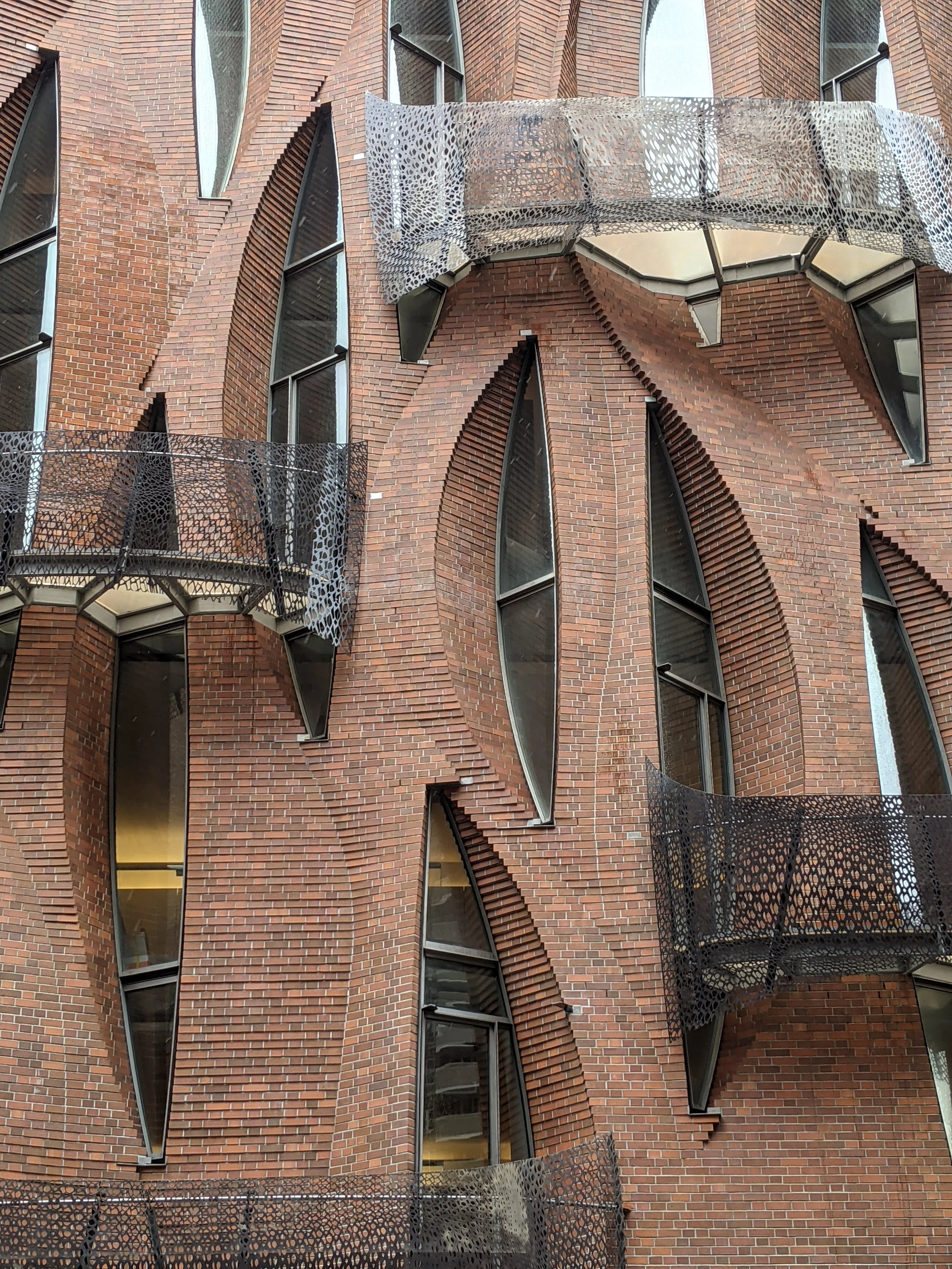
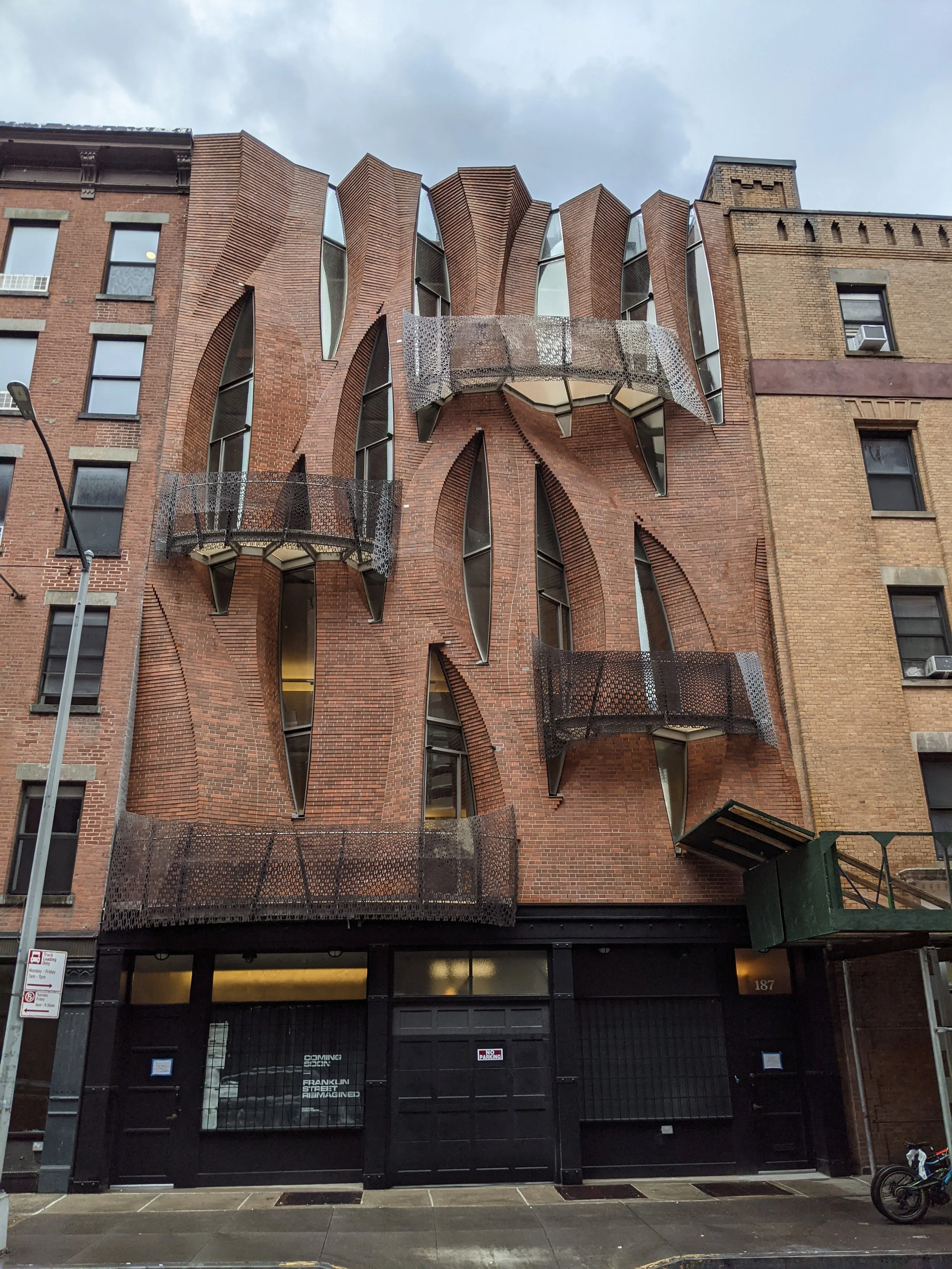
Unhistoric Townhouse | 187 Franklin Street
Original Construction: Contemporary (2010s)
Construction Type: Custom-engineered brick masonry façade with exposed interior and exterior brick surfaces
Category: Material Science / Building Technology
Architect: Jeremy Edmiston
Scope: Brick Masonry Consulting
Lessons in Contemporary Masonry, Material Continuity, and Thermal Discipline
Our team provided material science and façade consulting services to architect Jeremy Edmiston in support of the design and implementation of the masonry façade at Unhistoric Townhouse – 187 Franklin Street in New York City. The core challenge was reconciling an architectural expression of exposed brick on both the exterior and interior with the absence of conventional expansion joints, while still meeting current requirements for energy performance, durability, and constructability.
We worked closely with the design team to study and evaluate material behavior, focusing on thermal transmission, differential movement, moisture management, and long-term performance of masonry assemblies under real-world conditions. Our consulting role helped resolve the inherent tension between architectural intent and material reality, enabling the successful execution of a façade system that reads as seamless while quietly accommodating the forces acting upon it.
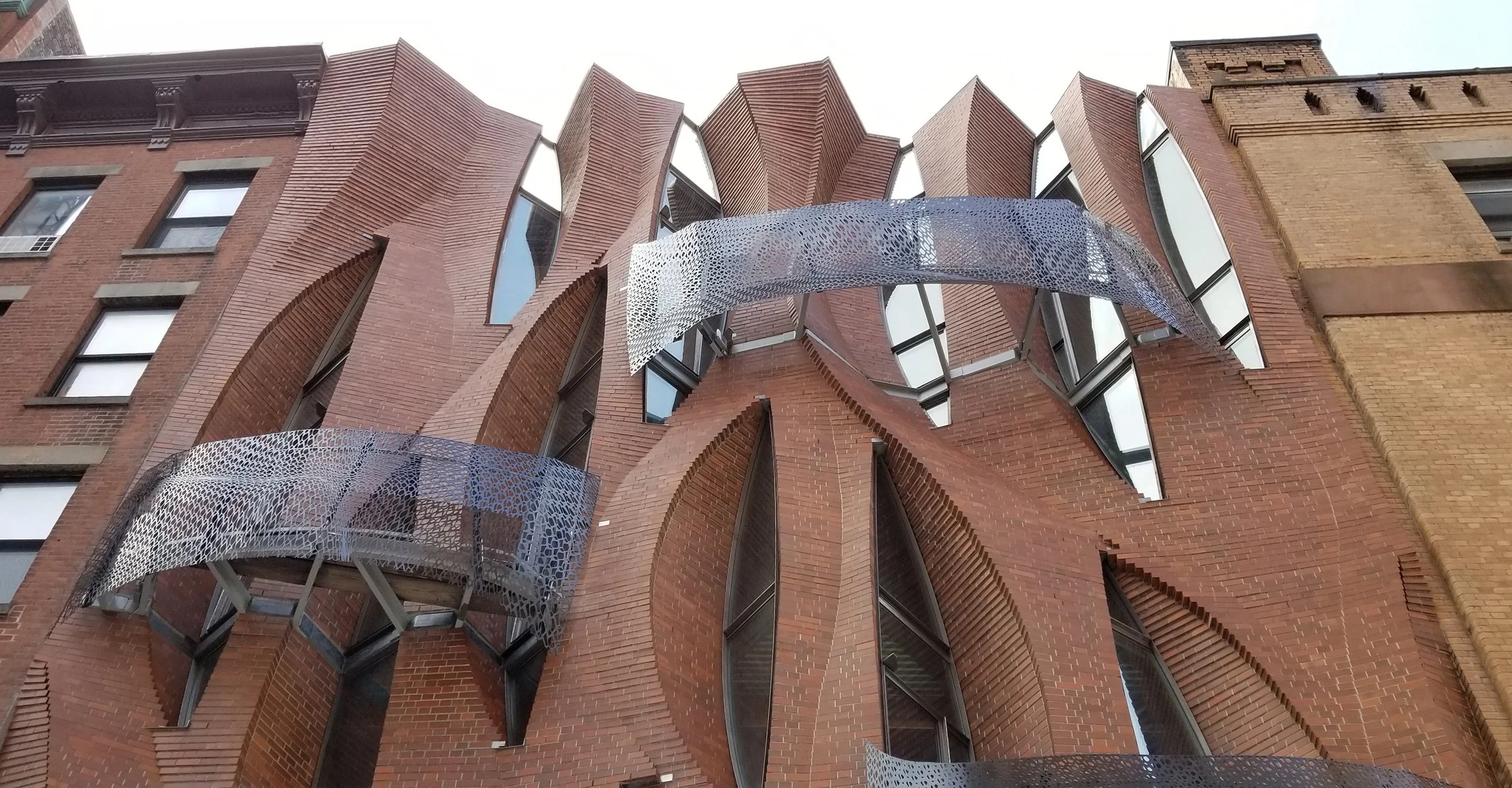
This posed a fundamental question:
How can a masonry façade behave monolithically while performing as a modern building envelope?
The Unhistoric façade represents a reinterpretation of load-bearing masonry principles within the constraints of energy performance, constructability, and urban regulation. This project explores how a traditionally monolithic material like brick, can function as both interior and exterior finish without expansion joints, when current construction practices mandate them. Through a layered masonry assembly informed by historical precedent and material science, the project bridges architectural intent and physical behavior.
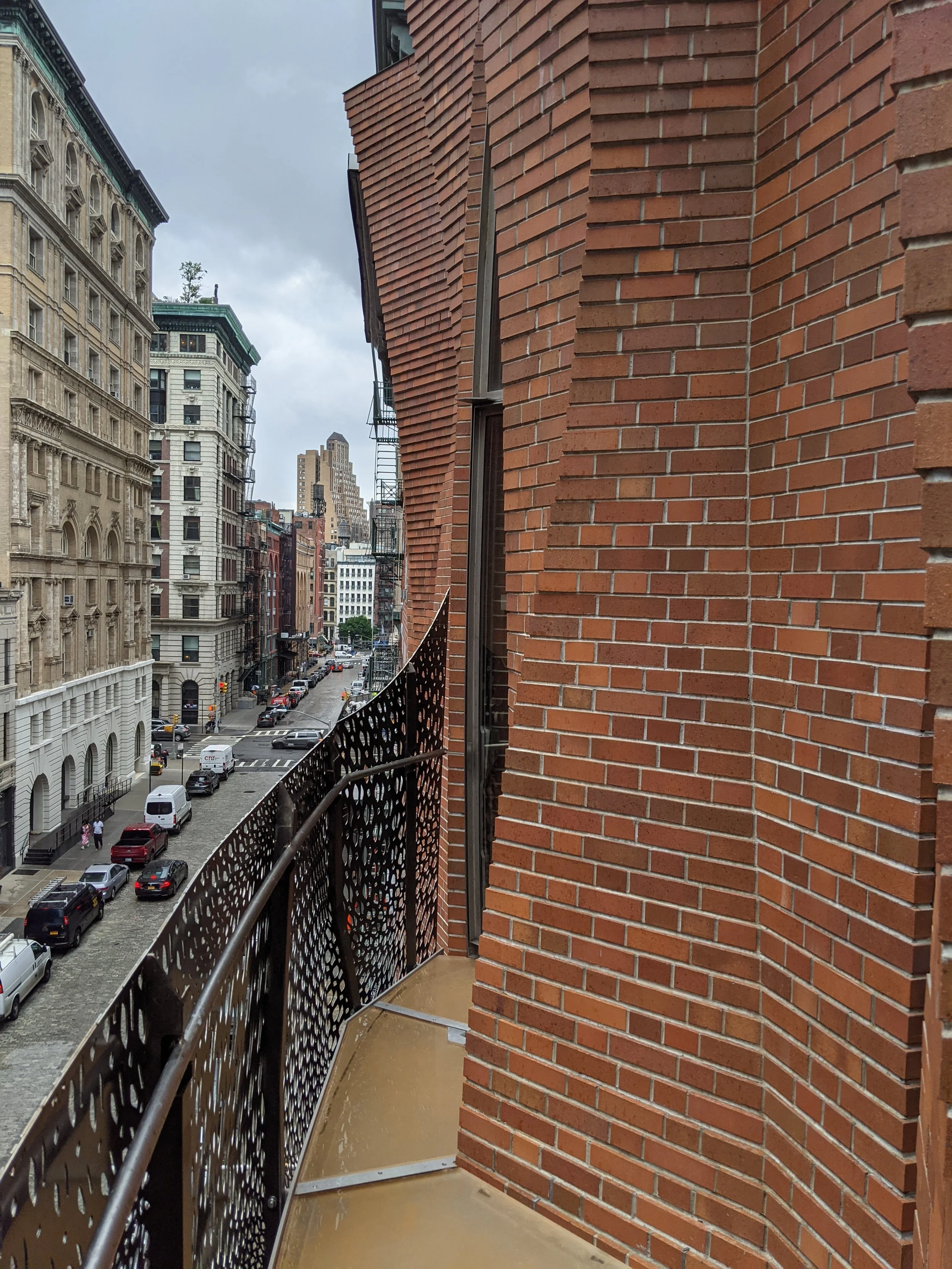
Historically, brick masonry functioned simultaneously as structure, enclosure, and finish. Wall thickness provided durability, moisture tolerance, and thermal inertia. In modern construction, masonry is more often reduced to a thin veneer, disengaged from performance and structure. At Unhistoric – 187 Franklin Street, architect Jeremy Edmiston sought to reclaim masonry as a spatial and material continuum, exposing brick on both the exterior and interior while rejecting the visual interruption of expansion joints.
Today, masonry construction typically separates responsibilities into discreet layers: structure, insulation with moisture control, and a ‘skin’ or cladding using a single wythe of brick. While efficient, this separation often results in visual and material fragmentation. The design intent at Franklin Street pushed against that fragmentation. The solution was a layered masonry assembly that reinterprets traditional multi-wythe construction through contemporary building science:
Two wythes of brick at the exterior, forming the weathering surface and establishing visual mass.
An intermediate layer of rigid insulation, shaped and detailed to align with brick geometry, preserving the perception of thickness while providing continuous thermal resistance.
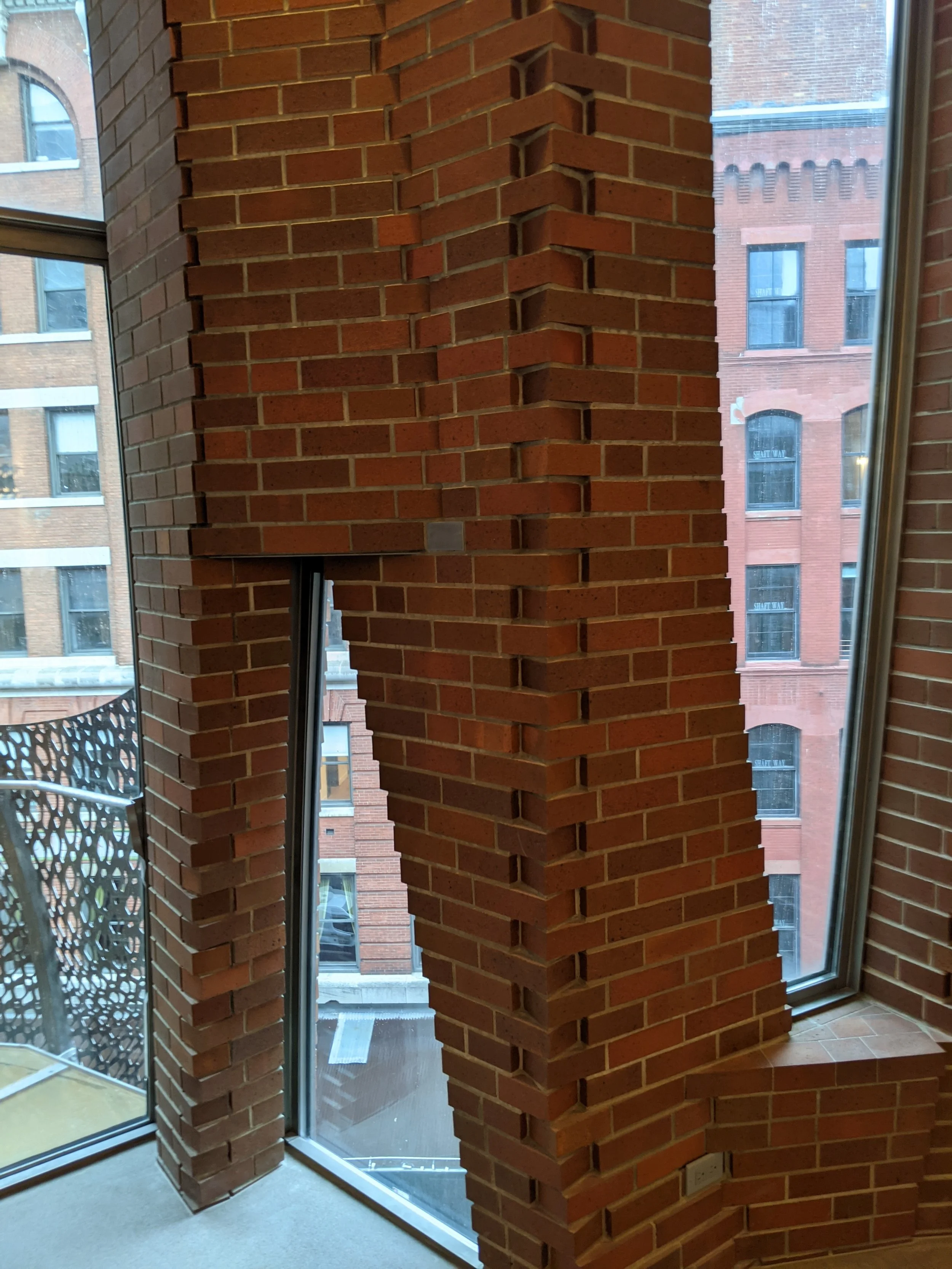
A single interior wythe of brick, installed between floor slabs, completing material continuity at the interior face.
This configuration allows thermal, moisture, and movement control to occur internally within the wall thickness, rather than being expressed through surface articulation. Performance is embedded within the assembly, not advertised on its exterior.
Brick moves. The challenge is not eliminating movement but deciding where it belongs. Expansion joints externalize movement, concentrating it at discrete locations and interrupting material continuity. At Franklin Street, movement is distributed across the depth and height of the assembly. Segmentation at the interior wythe between floors allows incremental vertical movement, while differential expansion between layers is absorbed across multiple wythes volumetrically rather than released along a single plane.
Unhistoric does not replicate the work of Louis Kahn, Frank Lloyd Wright, or Peter Zumthor. Instead, it translates their underlying logic of mass, continuity, and restraint into a new context shaped by energy codes, urban density, and construction realities.
What distinguishes this project is not its visual outcome, but its method. The wall was not drawn and then justified; it was studied through material behavior analysis, movement modeling, and constructability review prior to detailing. Questions of thermal transmission, differential movement, and long-term durability were treated as primary design inputs, not engineering afterthoughts.
At Unhistoric – 187 Franklin Street, brick is allowed to be heavy, continuous, and present again; not as nostalgia, but as a rigorously calibrated system.