519 Hudson Street | NYC
Original Construction Date: 1889
Construction Type: Solid load-bearing brick masonry with limestone, brownstone, terra cotta, and sheet-metal cornice
Landmark Status: Greenwich Village Historic District
Category: Material Science / Building Technology / Historic Fabric Conservation
Our Scope: Exterior Restoration and Preservation
Repair in Late-19th-Century Urban Masonry
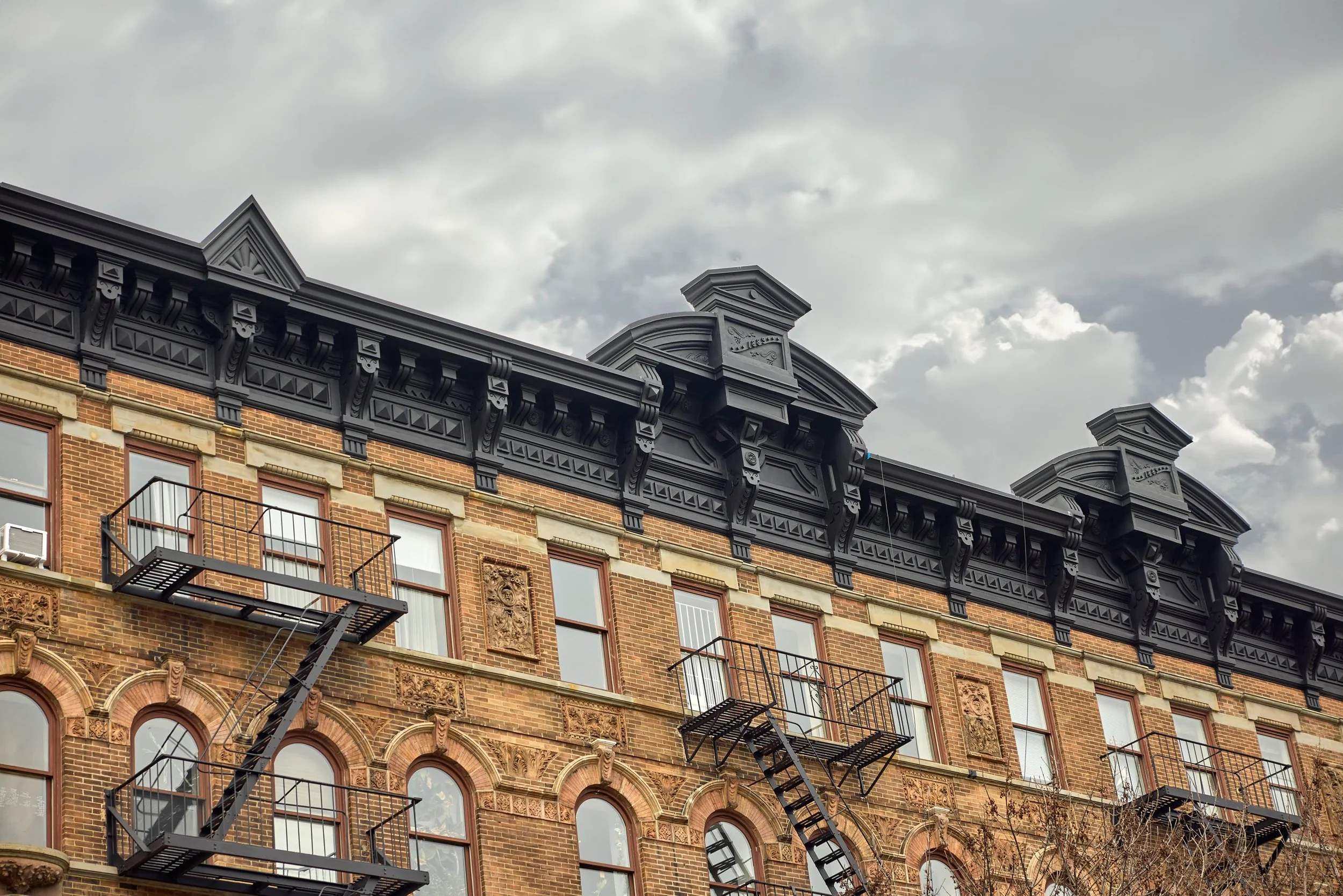
The restoration of 519 Hudson Street occupies a familiar but increasingly rare territory in contemporary façade practice: the disciplined repair of a fully realized nineteenth-century masonry system without rewriting its material logic. Constructed in 1889 as part of a unified group of five tenement buildings at the corner of Hudson and West 10th Streets, the building is a composite of Queen Anne, Romanesque Revival, and Renaissance Revival influences, executed in bonded brick masonry with integrated limestone, brownstone, terra cotta, and a continuous ornamental sheet-metal cornice.
Unlike later hybrid or transitional buildings, the original construction at 519 Hudson demonstrates a clarity of intent. Structure, enclosure, and finish are not separated into systems; they are collapsed into one thick, load-bearing wall. The challenge of restoration, therefore, was not to improve performance through modern substitution, but to stabilize, repair, and extend the service life of a system that already understood how to work, provided it was respected.
Our engagement focused on a forensic evaluation of façade distress patterns, material deterioration, and load paths, followed by the development of a comprehensive exterior restoration program suitable for Landmark Preservation Commission approval and DOB filing. The work required resisting the impulse to replace complexity with abstraction, or mass with membranes.
Stone That No Longer Exists
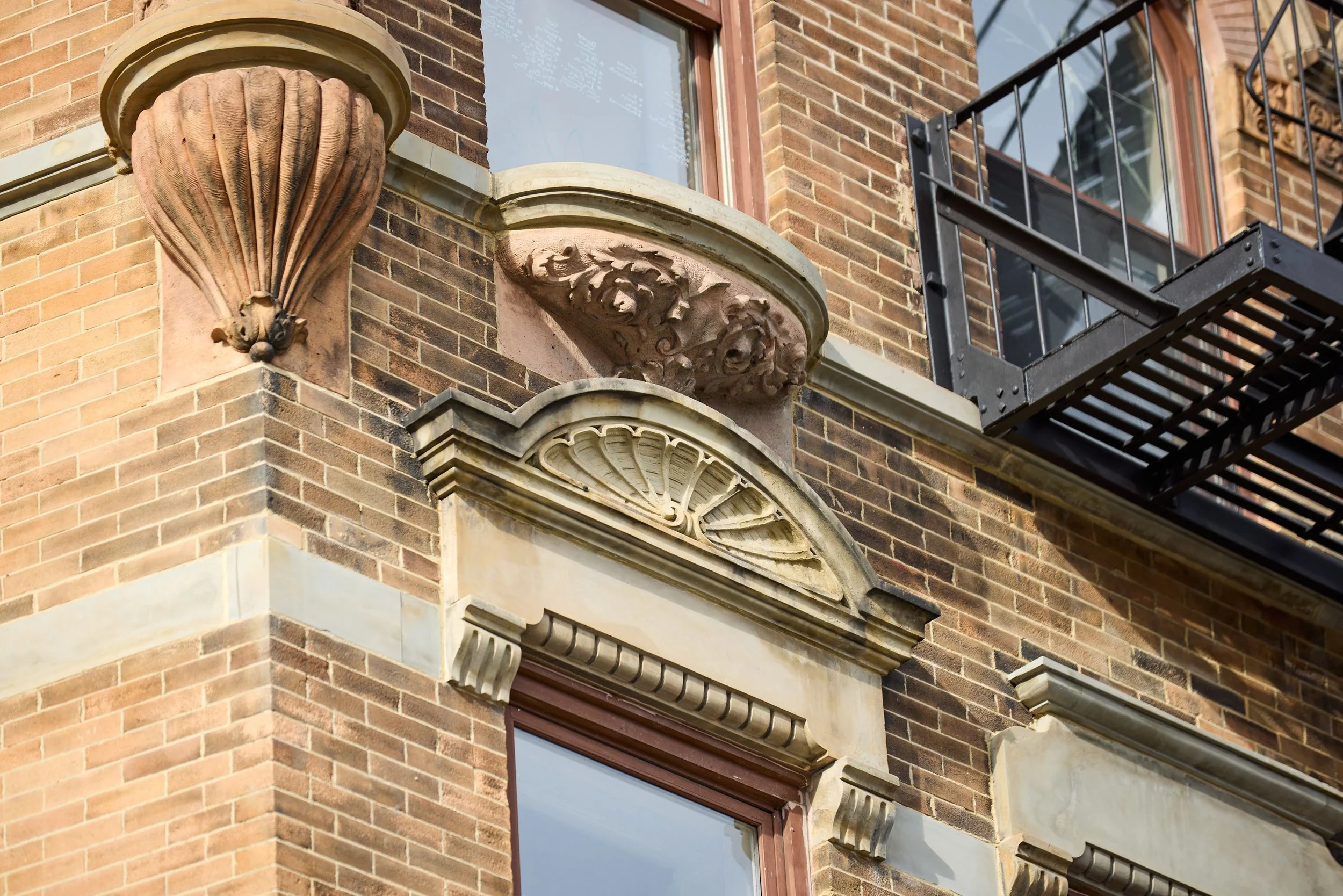
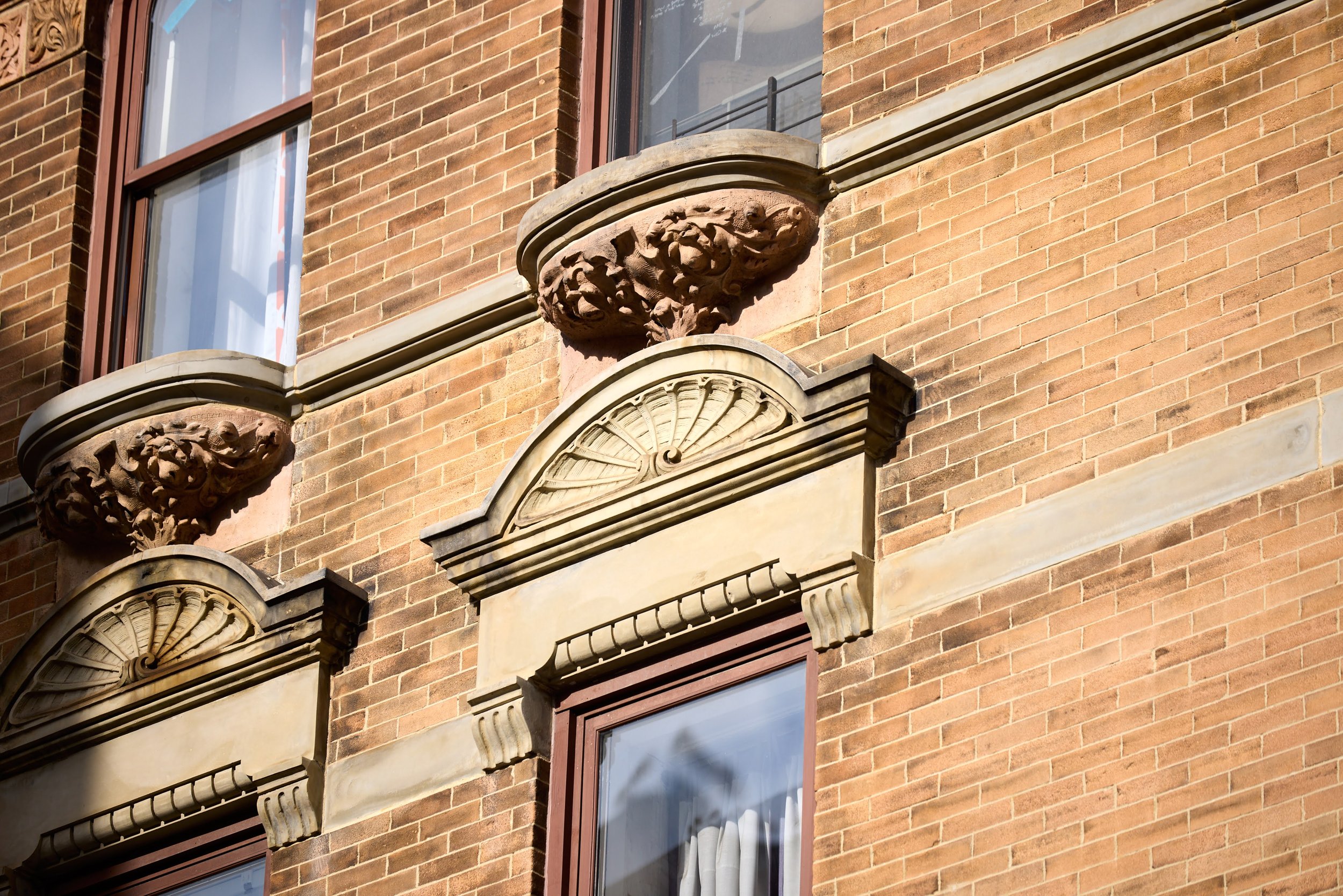
One of the defining technical challenges at Hudson Street was the extensive deterioration of stone elements at the façades, including window sills, projecting profiles, inset panels, and horizontal banding. Although broadly identified in historic documentation as “limestone,” material analysis revealed the stone to be an English chalk limestone, most likely Beer Stone, quarried in Devon during the late nineteenth century. This material is highly absorptive, mechanically weak relative to modern limestones, and critically, no longer quarried.
Replacement in kind, as required by the Landmarks Preservation Commission, was therefore impossible. Rather than defaulting to wholesale replacement with visually similar but materially incompatible stone, we developed a surgical conservation strategy: removal and cataloging of original stones, reshaping to remove failed material, reinforcement with stainless steel pins and epoxy, and casting of compatible backing material concealed within the masonry wall. The original stones were then reinstalled, preserving both appearance and historic fabric while quietly introducing structural redundancy.
Cornice as Structure
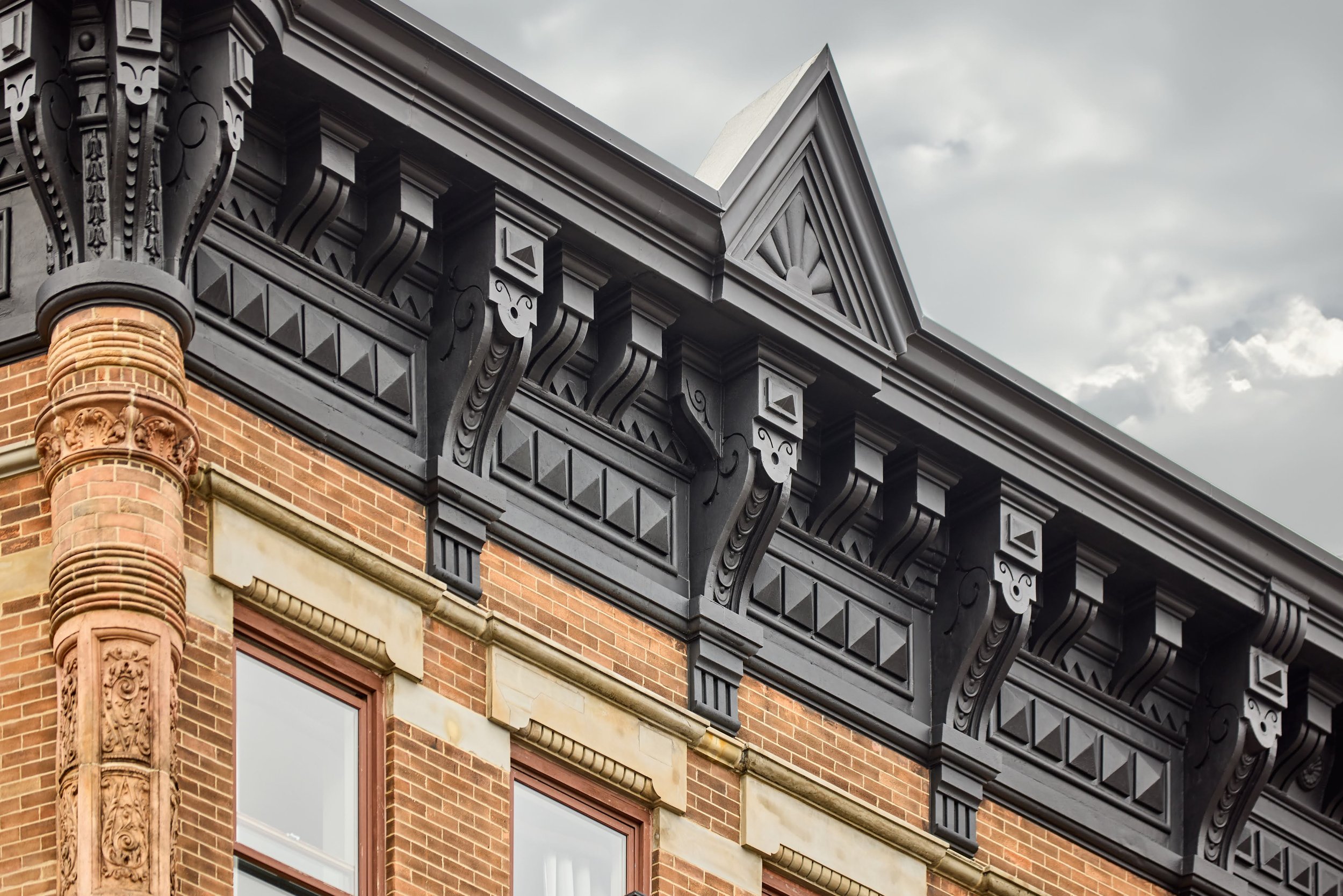
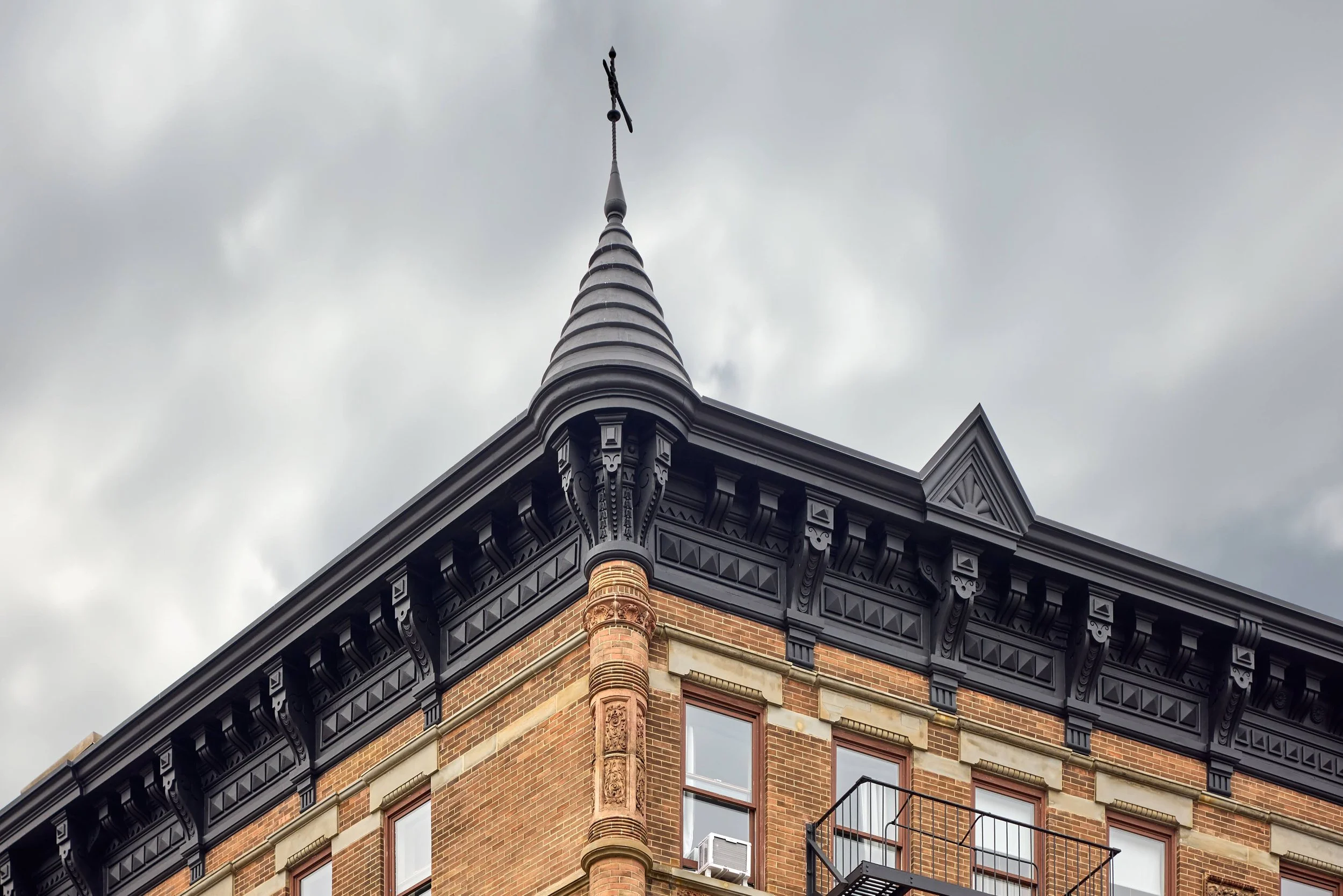
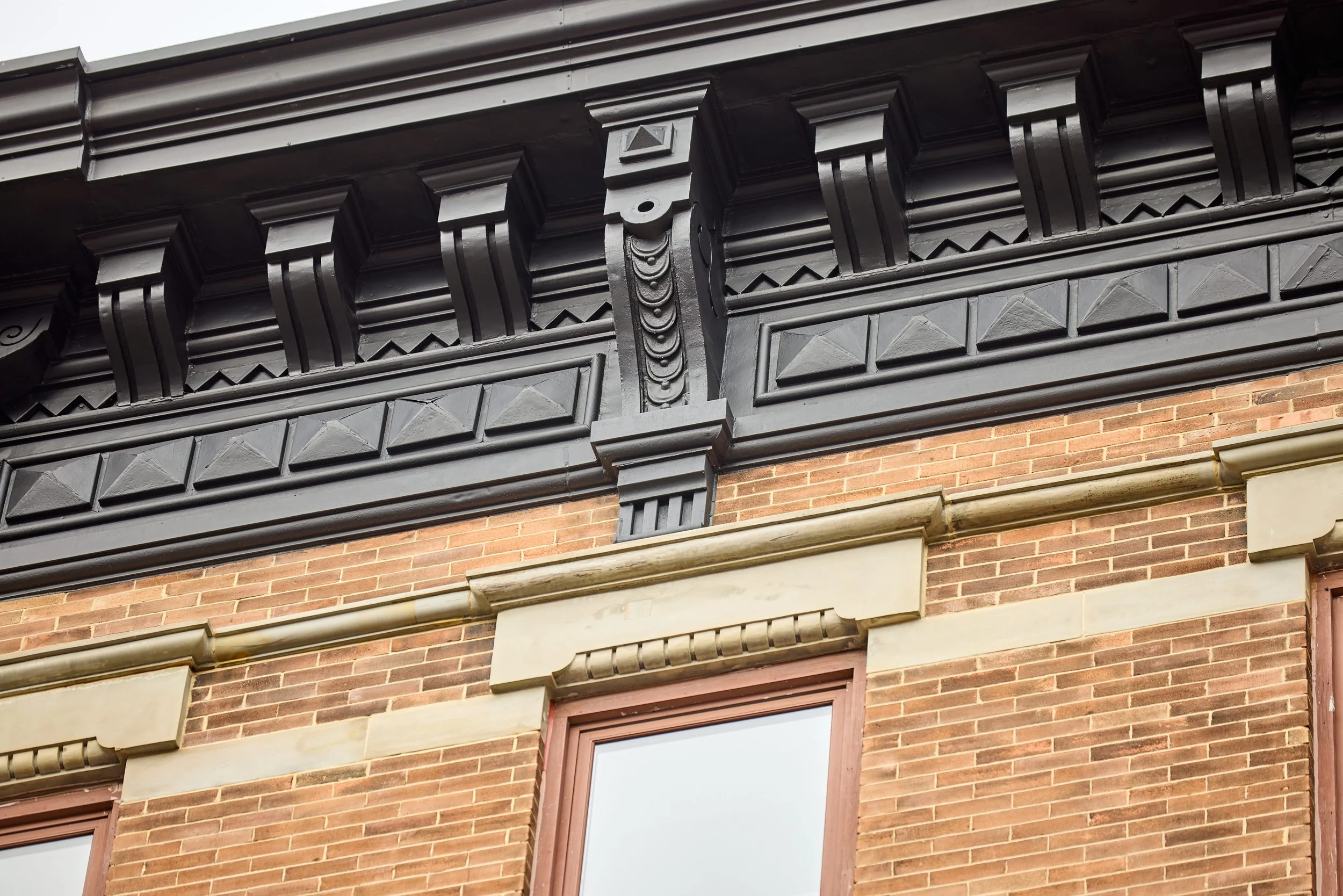
The continuous sheet-metal cornice, spanning all five buildings and culminating in an ornamental corner turret, represented another critical zone of failure. Time, moisture, and deferred maintenance had severely compromised the concealed wood armature, resulting in deflection, corrosion, and loss of bearing.
Rather than stripping the cornice and replacing it with a lightweight replica, we elected to treat the assembly as a hybrid structural system. The entire wood armature was removed from the interior side, temporarily supporting the historic metal components while a new pressure-treated structural frame was installed. Salvaged metal was repaired, patched, or selectively replaced, then reinstalled with new fasteners and coatings.
This process preserved not just the visual profile of the cornice, but its tectonic relationship to the wall below, maintaining the original hierarchy of mass, shadow, and termination that defines the building’s presence in the streetscape.
Preservation as Systems Thinking
What distinguishes the Hudson Street project is not any single repair detail, but the refusal to isolate problems from the system that produced them. Stone spalls were not treated as cosmetic defects. Cornice failure was not reduced to ornamental decay. Each condition was traced back to material behavior, moisture absorption, freeze-thaw cycling, differential movement, and gravity, within a solid masonry wall designed to be thick, continuous, and tolerant, not sealed or compartmentalized.